

Climate change, heat waves—the demand for air conditioners and professional installation is on the rise
Why a wall-penetration is necessary when installing an air conditioner
The system’s design is crucial for the proper installation of a split-system air conditioner.
Split systems—as the name suggests—consist of two components:
an indoor unit and an outdoor unit. Both units must be permanently and properly connected to each other via a wall duct.
The wall duct forms the basis for the closed refrigerant circuit. It houses the refrigerant lines, the condensate drain, and the electrical connection between the indoor and outdoor units. In practice, a protective conduit with the appropriate diameter is typically used for this purpose, providing sufficient space for all lines and enabling a clean installation.
Precise core drilling and proper routing of the lines are essential prerequisites for reliable and long-lasting system operation. Careful planning, suitable tools, and installation in accordance with standards facilitate the assembly and help simplify future service and maintenance work.
With the DOYMAfix® HP/O-S, you can rely on a professional wall penetration solution that reduces installation effort, enables a clean installation, and meets the highest standards for energy efficiency and leak tightness.
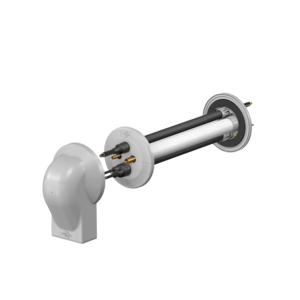
DOYMAfix® HP/O-S for air conditioners is the professional solution
The professional solution for cable entry in split air conditioning systems is the DOYMAfix® HP/O-S.
A clean wall penetration is crucial for the long-term safety and energy efficiency of split air conditioning systems.
With the DOYMAfix® HP/O-S, DOYMA offers the ideal solution for the professional routing of refrigerant lines, condensate lines, and power and control cables through the exterior wall of a building.
The wall penetration features integrated thermal insulation, separate routing of pipes and cables, and quick, easy installation. Thanks to its modular design, the DOYMAfix® HP/O-S can be flexibly adapted to different wall thicknesses and is suitable for both new construction and renovation projects.
Your benefits at a glance:
- Quick and easy installation
- Suitable for split-system air conditioners and split-system heat pumps
- Integrated thermal insulation to prevent thermal bridges
- Separate routing of piping, power cables, and control cables
- Universally applicable in various wall constructions
- Tested for airtightness, resistance to driving rain, and sound insulation to ensure a permanently secure building envelope
Do you need help with planning? We’d be happy to advise you personally and help you find the right solution for your project.
Background and Market Conditions
- The Air Conditioning Boom: High temperatures are driving demand for portable and permanently installed cooling systems to record levels.
- Heating with Heat Pumps: The focus is increasingly shifting toward heat pumps that offer an integrated cooling function in addition to heating.
Whether you're installing a heat pump or an air conditioner: Use our online planning tool to find exactly the right product!

Top Tip 1: Avoid Thermal Bridges from the Start
When installing air conditioning units, the wall penetration is often the weak point. With its integrated thermal insulation, the DOYMAfix® HP/O-S ensures a clean thermal break and helps meet energy efficiency requirements. This helps you avoid future complaints due to condensation or unnecessary heat loss.
Top Tip 2: Keep Cables Separated and Speed Up Installation
During installation, ensure a clear separation of piping from power and control cables. The DOYMAfix® HP/O-S is designed for this purpose and enables structured cable routing—which saves time on the job site and facilitates collaboration between HVAC and electrical trades.
Top Tip 3: Don’t Leave Sealing to Chance
A professionally executed penetration protects the building envelope in the long term. The DOYMAfix® HP/O-S offers tested properties such as airtightness and resistance to driving rain—ensuring that the installation remains reliably protected even with different wall constructions.
In short: Plan the proper penetration first, then install the HVAC unit—this saves on rework and ensures a professional finish.